
Project Technologies
technology
TT-10 Rotary Calcination Kiln
In the framework of WP2, the TT-10 Rotary Calcination Kiln will be used.
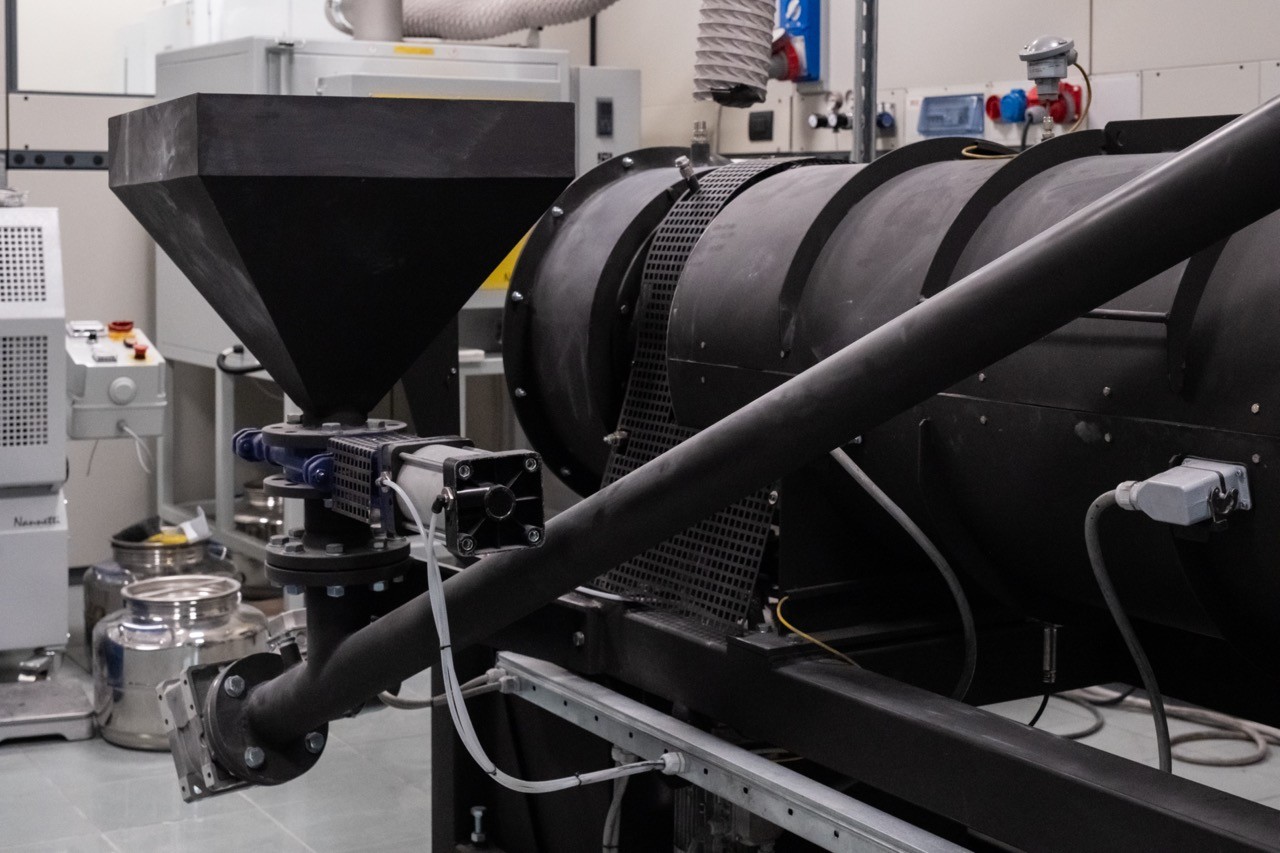
TT-10 Rotary Calcination Kiln is operational within the FIP WE@Unibo – CIRI FRAME laboratory. The system enables controlled experimental campaigns and pilot-scale calcination activities, processing tens of litres of material per operating cycle, and has been tested at pre-industrial scale.
The TT-10 allows measurement and optimisation of key process parameters to obtain tailored material properties, including high-reactivity quicklime, with the possibility to assess CO₂ recovery options during production. It can also be used to produce high-surface-area carbons from biomass and residues, typically in the range of 900–1200 m²/g.
technology
TT-10 Rotary Calcination Kiln
In the framework of WP2, the TT-10 Rotary Calcination Kiln will be used.
TT-10 Rotary Calcination Kiln is operational within the FIP WE@Unibo – CIRI FRAME laboratory. The system enables controlled experimental campaigns and pilot-scale calcination activities, processing tens of litres of material per operating cycle, and has been tested at pre-industrial scale.
The TT-10 allows measurement and optimisation of key process parameters to obtain tailored material properties, including high-reactivity quicklime, with the possibility to assess CO₂ recovery options during production. It can also be used to produce high-surface-area carbons from biomass and residues, typically in the range of 900–1200 m²/g.
technology
MOJITO rotary kiln
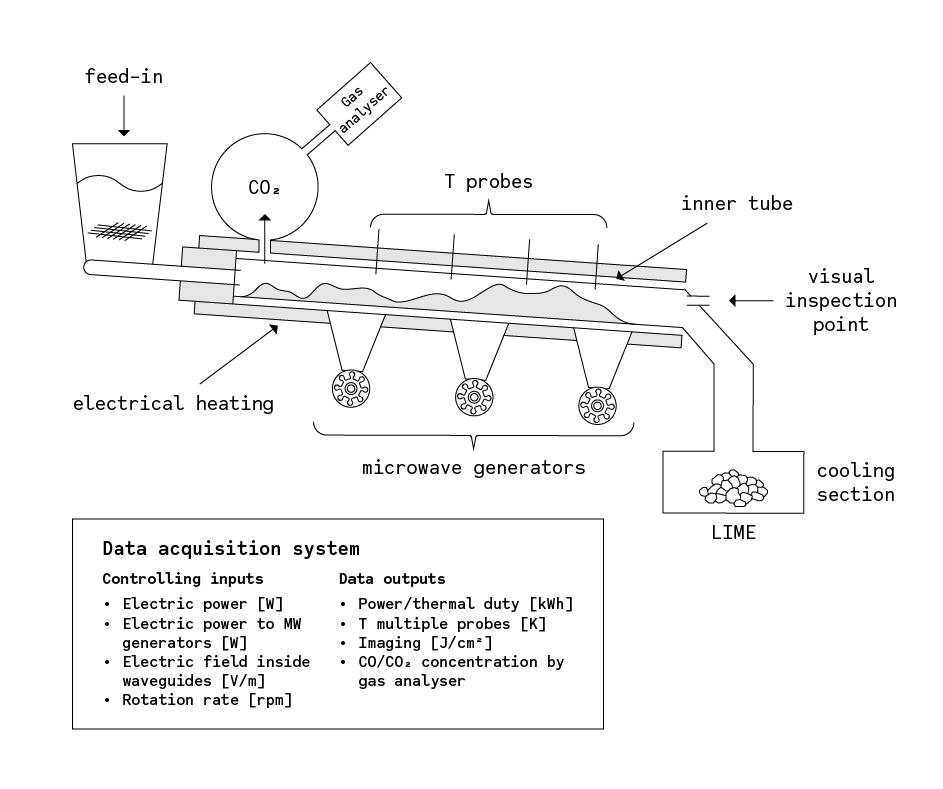
In the framework of WP3 a new rotary kiln will be build, designed to process up to 5 kg/h of material, with an adjustable operating temperature range of 500–1100 °C, variable rotational speed (2–8 rpm) and tilting capability (0–5°). It will be equipped with a feed hopper, a screw-based conveying system to introduce solids into the rotating tube, and a dedicated vessel for collecting the treated product. The tubular reactor, made of a microwave-transparent material, will integrate two heating systems that can operate independently or in coordinated mode. The electric heating unit will rely on Joule-effect resistive heating, enabling temperatures up to 1100 °C. The microwave system will operate at 915 MHz, featuring robust shielding to prevent leakage and an optimized configuration to ensure efficient energy transfer to the calcining feedstock. The kiln will also include fittings for inert gas (N₂) injection, as well as provisions to collect and analyse process gases generated during calcination, supported by an integrated data acquisition system.
A complete instrumentation to characterize the input material will be used: ICP-OES, TGA, CHNS, XRD, physisorption and dielectric probe kit.
technology
MOJITO rotary kiln
In the framework of WP3 a new rotary kiln will be build, designed to process up to 5 kg/h of material, with an adjustable operating temperature range of 500–1100 °C, variable rotational speed (2–8 rpm) and tilting capability (0–5°). It will be equipped with a feed hopper, a screw-based conveying system to introduce solids into the rotating tube, and a dedicated vessel for collecting the treated product. The tubular reactor, made of a microwave-transparent material, will integrate two heating systems that can operate independently or in coordinated mode. The electric heating unit will rely on Joule-effect resistive heating, enabling temperatures up to 1100 °C. The microwave system will operate at 915 MHz, featuring robust shielding to prevent leakage and an optimized configuration to ensure efficient energy transfer to the calcining feedstock. The kiln will also include fittings for inert gas (N₂) injection, as well as provisions to collect and analyse process gases generated during calcination, supported by an integrated data acquisition system.
A complete instrumentation to characterize the input material will be used: ICP-OES, TGA, CHNS, XRD, physisorption and dielectric probe kit.