
Project Overview

Mojito
Technical Summary
MOJITO aims to validate a laboratory-scale system for producing decarbonised lime with lower energy demand and reduced calcination-related CO₂ emissions, while enabling CO₂ removal. The concept relies on an electrified rotary kiln integrating hybrid microwave and electrical heating to deliver heat directly to the calcining material.
- Thanks to microwave penetration into limestone particles, the process can operate at lower temperatures than conventional systems.
- The feedstock is complemented with carbonaceous additives that enhance electromagnetic energy absorption and convert it into heat, improving overall process efficiency.
- The CO₂ released during calcination is collected in a dedicated external vessel, enabling downstream CCU/CCS pathways.
- In parallel, MOJITO will perform atomistic simulations of CaCO₃ calcination under realistic conditions, leveraging machine-learning force fields and Tier-0 supercomputing to resolve key mechanisms and guide the design and optimisation of the MOJITO system.
- The project targets lime quality grades covering up to 70% of market demand.
Mojito
Technical Summary
MOJITO aims to validate a laboratory-scale system for producing decarbonised lime with lower energy demand and reduced calcination-related CO₂ emissions, while enabling CO₂ removal. The concept relies on an electrified rotary kiln integrating hybrid microwave and electrical heating to deliver heat directly to the calcining material.
- Thanks to microwave penetration into limestone particles, the process can operate at lower temperatures than conventional systems.
- The feedstock is complemented with carbonaceous additives that enhance electromagnetic energy absorption and convert it into heat, improving overall process efficiency.
- The CO₂ released during calcination is collected in a dedicated external vessel, enabling downstream CCU/CCS pathways.
- In parallel, MOJITO will perform atomistic simulations of CaCO₃ calcination under realistic conditions, leveraging machine-learning force fields and Tier-0 supercomputing to resolve key mechanisms and guide the design and optimisation of the MOJITO system.
- The project targets lime quality grades covering up to 70% of market demand.
Mojito
Project Work Packages
MOJITO is a 3-year project whose results will be delivered through six Work Packages. The WPs also include dedicated activities on communication, dissemination and exploitation to ensure that project outcomes can be advanced towards pilot demonstration and, ultimately, commercial deployment. The project work packages are shown in the figure and described below.
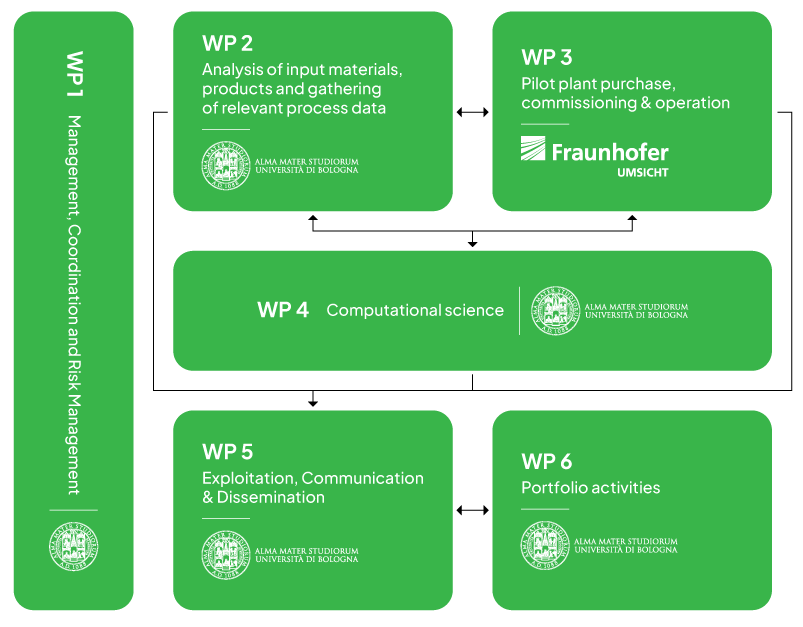
Mojito
Project Work Packages
MOJITO is a 3-year project whose results will be delivered through six Work Packages. The WPs also include dedicated activities on communication, dissemination and exploitation to ensure that project outcomes can be advanced towards pilot demonstration and, ultimately, commercial deployment. The project work packages are shown in the figure and described below.

General Objective: To ensure efficient management of the project by the establishment and operation of an effective consortium management structure.
(WP led by University of Bologna)
WP1 Specific Objectives:
- Provide organisation and management of consortium activities including the consortium agreement, partner interactions, timescales, budgets and communication with the Commission, any overall legal, IP, contractual and ethical management issues.
- Coordination of the scientific, technological and administrative efforts of the various partners.
- Organise of all management workshops and meetings, including the general assembly meetings, mid term and final review.
- Monitor issues related to ethics, gender equality and early-career researchers.
- Handling of risk assessment and management.

WP2 General Objective: To systematically collect, process, and evaluate data related to input materials, products, and relevant process data. To enable informed and data-based discussions and decisions regarding observations and research results.
(WP led by University of Bologna)
WP2 Specific Objectives:
- To provide a systematic knowledge base for research in the project through chemical/physical analysis of all input materials and pre-treated mixtures of carbonaceous and carbonate compounds.
- To ensure a comprehensive understanding of the behaviour of mixtures of carbonaceous and carbonate compounds undergoing E/MW-heating.
- To prepare materials for calcination tests.
- To prepare materials for calcination tests.
- To provide measurements and data processing for outputs from T3.2 and T3.3.
- To store and efficiently process all data from experimental runs, such as energy intensity, carbon intensity, and calcination rate and to directly link process data with an integrated interface to laboratory analysis results as a basis for the profound evaluation of the technical performance

WP3 General Objective: To select fit-to-purpose configuration, purchase and operate a hybrid dual-mode calcination system with up to 5 kg/h capacity, consisting of a rotary kiln for continuous operation equipped with an electric (E) and a 915 MHz microwave (MW) heating system which can work separately or jointly in an airtight environment with CO2 collection in a separate vessel.
(WP led by Fraunhofer)
WP3 Specific Objectives:
- To select and purchase a hybrid E/MW rotary kiln configuration.
- To manage commissioning and preparation of the rotary kiln.
- To prepare the DoE and to run test and measures.

WP4 General Objective: Describe the calcination reaction from first principles and perform large scale atomistic simulations of the whole calcination process in the conditions present within the rotary kiln. The simulations, based on first principles and MLFF-MD approaches, will unravel the atomistic mechanisms of the CaCO3 calcination and the role of PCMs and environmental molecules.
(WP led by University of Bologna)
WP4 Specific Objectives:
- Evaluation of the calcination reaction paths and energy barriers for the most relevant CaCO3 polymorphs (i.e., calcite, aragonite, and vaterite) through DFT calculations.
- Accurate atomistic simulation of the calcination process in different operando conditions by means of large-scale MLFF-MD.
- Identification of the predominant mechanism of PCMs MW absorption and of the impact of system size, shape, and functionalization.

WP5 Specific Objective: To deliver the dissemination, exploitation, and communication strategy in order to raise the profile of the NET Fuels process and secure commercial and political buy-in.
(WP led by University of Bologna)
WP5 Specific Objectives:
- Develop and continuously update the exploitation, dissemination and communication plan.
- Deliver the exploitation strategy.
- Communicate the project results.
- Deliver the dissemination strategy.

WP6 General Objective: Explore synergies and collaborations among the projects of the portfolio, to maximize the achievement of the scientific results, the exploitation potentials, the outreach opportunities with key stakeholders, the identification and overcoming of major barriers to introduce the innovation to the market.
(WP led by University of Bologna)
WP6 Specific Objectives:
- Contribute to the elaboration of the strategic plan of portfolio and sub-portfolio.
- Developing a common understanding within the portfolio members of the existing and developing regulatory environment in view of the future implementation of the technologies that are developed by the portfolio members.
- Sharing life cycle analysis and life cycle thinking and developing novel/common metrics or ways of benchmarking the potential impact associated with each solution.
- Define common scenarios and strategies for commercialization and exploitation.